Showing posts with label art. Show all posts

Sunday, May 3, 2020

Human art vs AI art


Below you see an image that I airbrushed (the analog type with a compressor, an airbrush gun and real paint) during a fair in Utrecht, The Netherlands, demonstrating for the Revel company that sold airbrushes and paints. It was sprayed on a T-shirt with a Vega 1000 airbrush and Illu-Color paint in the early 90's of the previous century. Years later I found a photo of it that I digitally reworked in Affinity Photo. When conducting demonstrations for Revel I almost exclusively airbrushed portraits of Native American chiefs, because apart from their facial traits that struck me, the stories of their lives intrigued me. I could place the images in a context and in doing so make my perceptions more profound.


Comanche chief Quanah Parker - freehand airbrush on T-shirt
years later digitally reworked in Affinity Photo


Already in those days I wasn't interested in shallow people and things. This got worse over the years, haha! Fluffy stuff just isn't my thing. It bores me senseless and I can not find it within myself to attribute any interest to it. Quanah Parker was an intriguing person. His mom, Cynthia Ann Parker was captured by the Comanche, she married a chief and gave birth to Quanah, which means 'fragrant'. Later she was recaptured by her Caucasian family, but tried to escape several times to rejoin the Comanche. She never succeeded in doing that and never saw her son again. Quanah meanwhile had become a legendary warrior chief who never lost a battle to the colonial British army. At one point though he realized that continue to fight would decimate his people after which he voluntarily surrendered.

In the western colonial society Quanah became a successful business man and politician. He had bought himself a big mansion, but always preferred to sleep in the garden at night. To me that meant that his intelligence and wisdom included aspects that were entirely alien to that of the western world to which he had adapted to a certain level. Quanah clearly had retained fragments of the perception and awareness of the environment in which he was raised and in which he had lived an intense life, characterized by engaging in battles of life and death with mortal enemies. The fact that he later concluded that it was to the benefit of his people to stop fighting, reflects the power of his mind, his empathetic character traits and ability to accurately estimate future events.

All the things above, went through my mind when creating the portrait of this legendary man. My portrait was some sort of a visual tribute to him that perhaps in a modest way re-created the awareness of his existence. I was unable to think of an other reason why I did this, realizing that to most people airbrushing his portrait meant nothing at all. But that is what happens all the time in life in this dimension; what interests one person, others are totally oblivious to. Which brings me to the fact that I often see art on the Internet that I find intriguing that is completely ignored by the art world. It causes me to wonder what criteria are used to determine what is good art and what art is not even worth giving any sort of attention. I am not talking about the financial value of artworks, although that often indicates how people in the art world think.

Besides art created by human artists, since recently art created by AI (artificial intelligence systems) has gained ground in the perception of the general public. Of course 'influencers' play a role in the acceptance of AI-art. People and organizations that have moved themselves into a position of authority, to a great extent decide what to look at and what to buy. The 'artwork' below was created by AI and promoted by Christie's auction house. I suspect that creating markets is part of the consideration that Christie's may have had to feature this art, but saying such a thing is of course 'not done', it isn't a politically correct thing to do, because well... Christie's knows what art is and the rest of the world is simply expected to follow their lead without questioning their expertise.


'AI-art' - portrait of the fictional person Edward de Belamy


The above is a portrait of a fictional person that the AI-system named Edward de Belamy. Although it seems a bit strange to hide almost half of Edward's virtual face behind the frame, it sold for $432,500.00 ( . . . ) nevertheless. I don't know about you, but to me it feels like besides the 'art' an entirely new context - portrait art of fictional people made by AI-systems - was created. It probably was estimated to be a category into which a certain future number of artworks would become eligible to be sold, while inventing such a category was probably aimed at turning it in to an accepted development has the potential to open up markets that did not exist before. Art buyers and collectors love to be trend-setters, so this was quite a smart move by Christie's marketeers. This of course is all pure speculation on my part, but don't be surprised if my suspicions will turn into reality soon. Oh, and should you become interested in the artist's 'art work', its name rolls off the tongue quite easily:


Remember that name and start clearing the walls in your residence to make space for art work that is created by AI-systems. You may also want to check the depth of your pockets, because this new type of art certainly does not come for free. I am not sure how they will go about the certificate of authenticity, but they will probably figure out a way how to go about that.


Hasta luego online virtual folks.


Sunday, April 26, 2020

Meta data in art - what is it?


Good question if I say so myself. Much of the art I encounter on the web today, kind of makes me go [insert long lasting flatulent dissonance]. This goes for digital art in particular. Not that I believe that I am one of the few to make proper art and most artists don't, but I just find myself being unable to pass appreciation for 'artwork' that obviously required very little inspiration, skill and commitment to create. However, somehow this type of one-horse, amateurish fiddling seems to have become some sort of standard that has gained a huge following. Portfolio sites are teeming with such rubbish and the views and likes of them suggests that the average person is quite fond of crappy tinkering. The public of course likes to be told what they should appreciate, which probably is why the circus of unaware and cheap rubble works just fine.

Most artists promptly give up creating true art, because it saves them time and effort. Boggling unskilled junk is so much easier than sweating ones balls of (pardon my French) to create something really inspired and meaningful. A consequence of such mindless conduct is that vast armies of incompetent bunglers all of a sudden are able to pretend to be artists. The sad thing is that the public actually believes that this is the case and as a result shiploads of worthless bunk is sold. Here you see a shameless example of modern ignorance.

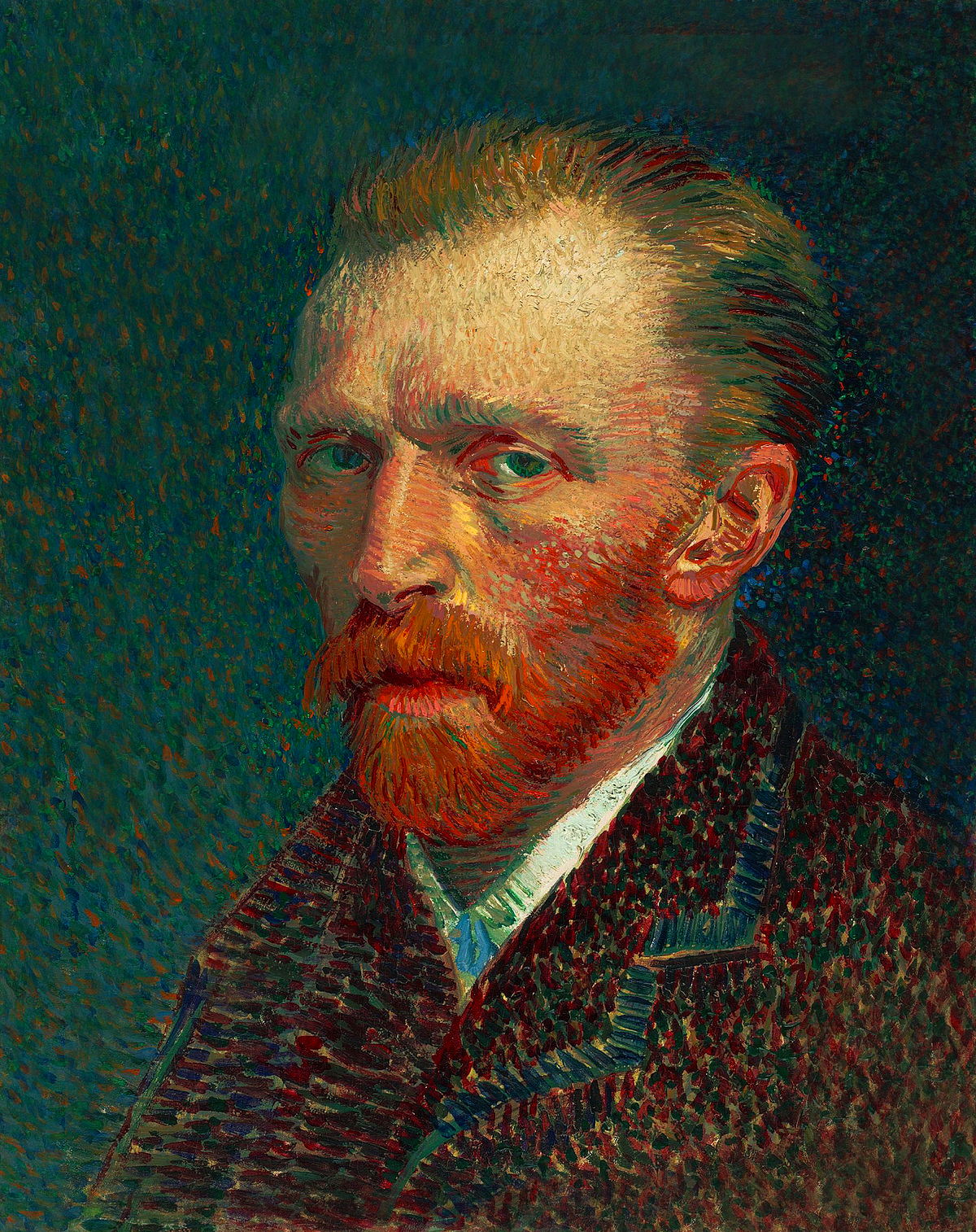
I fear this deplorable situation isn't going to change any time soon, which is a shame in particular for artists that remain true to themselves, true to art. It is a sign of the times; impostors rule and the genuine are scorned and starve. There is of course a reason for things to develop into such a suspicious direction. For instance: Vincent van Gogh sold only one painting during his entire life, earning close to nothing from it, but today the art trade criminals make millions from selling his works. His art has become an investment rather than an inspired creation that one cannot stop enjoying by looking at it. The rich often buy and sell art for this reason. But art is more emotion than reason.


Vincent van Gogh


In Van Gogh's work an obvious style is visible like many other great artists that created art that is immediately recognizable as work painted or sculpted by them. This is the visual signature that reflects the personality of artists. Their brush strokes, palette and preference for certain styles, scenes and subjects refer to them; it is a complex combination of aspects that tell the trained observer which artist made which artwork. But such intriguing intricacy is often absent in the smelly garbage heap of today's art.

I have not studied art or art history, but I immediately recognize certain types of art. Art in which shapes are built and arranged based on the lines of the golden mean, symbolism, hidden symmetry and other subtle visual denotations to (mostly ancient) knowledge, features that many observers fail to detect. It makes the experience of enjoying art more profound and powerful, because the occult aspects were brought to consciousness. It is exactly what I notice to be absent in much of modern art. Albert Camus expressed this in an exact and eloquent way: '... a product of the untalented, sold by the unprincipled to the utterly bewildered'. In this case he spoke about abstract art, but his words apply to all sorts of useless modern rubble.


Greatest inventor of all time:
Nikola Tesla


The crux of the above is that true art often contains meta-data; information that is present, but not always easily detectable. This unobvious type of information is present in a kind of concealed way in analog art; painting and sculptures - the traditional art forms. In digital artwork it is even more difficult if not impossible to detect, but that does not automatically mean it is absent. I often assign values to drawing functions, values related to the numbers Nikola Tesla preferred (numbers divisible by 3 often) or numbers from the vortex based mathematics that were re-discovered by Marko Rodin. These aspects are too deeply hidden to be detected with the naked eye. It resembles the concealing of code in certain parts of the bible, particularly the version written in Hebrew letters. It requires advance decoding to detect, but the coding is there nevertheless. In such works the unapparent can repulse the obvious.


Marko Rodin


So, what is the use of such occult data in art? In certain scientific circles it has been established that humans see much more than they become aware of. A part of the information that the eyes detect never becomes part of awareness. It is observed and after a while sinks into the unconsciousness where it is stored in the deep dungeons of memory, which is often incorrectly referred to as being forgotten. Therefore there is no apparent use for it, but what is apparent or not can also mean the opposite when digging deeper into the way that the human mind works. In today's science it is unsafe to speak or write about consciousness, especially when it is claimed to be an entity that exists outside of the brain. But I am sure this view will change at some point in time. Perhaps that instant will be incited by an art loving scholar enjoying the splendor of a true work of art. That would confirm the significance of inspired creativity and a mind that is open to the unknown. A collaboration of features that has been disregarded too often for too long by too many.


Hasta luego online virtual folks.